Yes, you can perform CPR on someone with a pacemaker. If a person with a pacemaker becomes unresponsive and is not breathing normally or is only gasping, CPR should not be delayed because of the implanted device. Start CPR, activate emergency services, and use an AED as soon as one is available.
A pacemaker is designed to help regulate the heart’s rhythm, but it does not prevent cardiac arrest or eliminate the need for emergency resuscitation. Knowing where the device is located and how it affects CPR and AED use can help you respond appropriately without delaying lifesaving care.
This guide explains whether you can perform CPR on someone with a pacemaker, how to perform chest compressions, whether an AED can be used, what to do if the device is visible or easy to feel, and how CPR differs when the person has an implantable cardioverter-defibrillator (ICD).
Can a Person With a Pacemaker Go Into Cardiac Arrest?
Yes, a person with a pacemaker can still experience cardiac arrest. A pacemaker helps regulate the heart’s rhythm by delivering electrical impulses when needed, but it does not prevent every dangerous heart rhythm or every condition that can cause the heart to stop pumping blood effectively. Several conditions can cause cardiac arrest in a person with a pacemaker, including ventricular fibrillation, certain types of ventricular tachycardia, and other serious cardiac problems.
Therefore, having a pacemaker does not change the immediate response to suspected cardiac arrest. If a person with a pacemaker collapses and is not breathing normally or is only gasping, activate emergency services, begin CPR, and use an automated external defibrillator (AED) as soon as one is available. Learn what to do if a person with a pacemaker collapses for more guidance on responding to this emergency. Do not delay resuscitation to check the pacemaker or determine why the person collapsed.
Does a Pacemaker Prevent You From Doing CPR?
No. A pacemaker does not prevent you from doing CPR. If an adult is unresponsive and is not breathing normally or is only gasping, treat the situation as a potential cardiac arrest. The AHA recommends starting chest compressions and activating the emergency response system rather than waiting to determine whether the person has a pacemaker.
The concern about damaging an implanted device should not prevent you from providing lifesaving chest compressions.
For adult CPR, the AHA recommends:
- Push in the center of the chest.
- Compress at a rate of 100–120 compressions per minute.
- Compress to a depth of at least 2 inches (5 cm) in an average adult.
- Allow the chest to return fully between compressions.
- Minimize interruptions in chest compressions.
If you are an untrained bystander witnessing a teen or adult suddenly collapse, Hands-Only CPR, calling emergency services and pushing hard and fast in the center of the chest, is an appropriate approach.
How to Do CPR on Someone With a Pacemaker?
CPR on someone with a pacemaker follows the same basic technique as standard adult CPR. A pacemaker does not change chest compression depth, rate, or hand placement. If the person is unresponsive and is not breathing normally or is only gasping, begin CPR immediately. Do not delay resuscitation because of the implanted device.
- Check scene safety: Before approaching the person, make sure the surroundings are safe for you, the person, and anyone assisting. Look for hazards such as traffic, fire, electrical dangers, or other immediate risks.
- Check responsiveness and breathing: Tap the person’s shoulders and shout to check for a response. Check whether they are breathing normally. Occasional gasping is not normal breathing and can indicate cardiac arrest. If the person is unresponsive and not breathing normally, activate emergency services and begin CPR.
- Activate emergency services and get an AED: Call your local emergency number or direct someone else to call. Ask another person to retrieve an automated external defibrillator (AED), if available. If you are alone, use your phone’s speaker function to follow the emergency dispatcher’s instructions while beginning resuscitation.
- Position the person properly: Place the person on their back on a firm, flat surface. Expose the chest to identify the correct hand position and allow AED pad placement.
- Place your hands in the center of the chest: Position the heel of one hand over the lower half of the breastbone (sternum), with the other hand on top. Keep your hands in the standard CPR position rather than shifting them to avoid the pacemaker, which is commonly implanted beneath the skin in the upper chest.
- Perform high-quality chest compressions: Push hard and fast at a rate of 100–120 compressions per minute. For an average adult, compress the chest approximately 2 inches (5 cm) deep, avoiding depths greater than 2.4 inches (6 cm). Allow the chest to recoil completely after each compression and minimize interruptions.
- Provide rescue breaths if trained: If trained and able to provide conventional CPR, give 30 chest compressions followed by 2 rescue breaths. Each breath should last about one second and make the chest visibly rise. If you are untrained or unable to give rescue breaths, perform hands-only CPR by giving continuous chest compressions and following the emergency dispatcher’s instructions.
- Use an AED as soon as it is available: Turn on the AED and follow its voice or visual prompts. Place the pads on the bare chest according to the diagrams, ensuring that a pad is not placed directly over the pacemaker’s implanted bulge. If necessary, position the pad slightly away from the device while maintaining the recommended pad placement. Do not delay defibrillation because the person has a pacemaker.
- Resume CPR promptly and continue until help takes over: Follow the AED’s instructions and immediately resume chest compressions after a shock or when the AED instructs you to continue CPR. Continue resuscitation until the person shows clear signs of life and is breathing normally, trained emergency responders take over, or the scene becomes unsafe.
Can You Use an AED on Someone With a Pacemaker?
Yes. It is safe and recommended to use an AED during CPR when a person with a pacemaker is in cardiac arrest. An AED is designed to analyze the heart rhythm and deliver a shock when a shockable rhythm is detected. For detailed guidance, learn more about Can You Use an AED on Someone With a Pacemaker?.
For someone with a pacemaker:
- Start CPR immediately if they are unresponsive and not breathing normally.
- Use an AED as soon as it is available.
- Do not place an AED pad directly over a visible or palpable pacemaker.
- Follow the AED’s voice or visual instructions.
- Do not touch the person while the AED is analyzing the rhythm or delivering a shock.
- Resume CPR immediately when the AED tells you to do so.
So, AED use is not something separate from CPR. CPR and AED use work together during cardiac arrest: CPR maintains circulation while the AED assesses the rhythm and provides defibrillation when indicated.
What If the Pacemaker Is Visible or Easy to Feel?
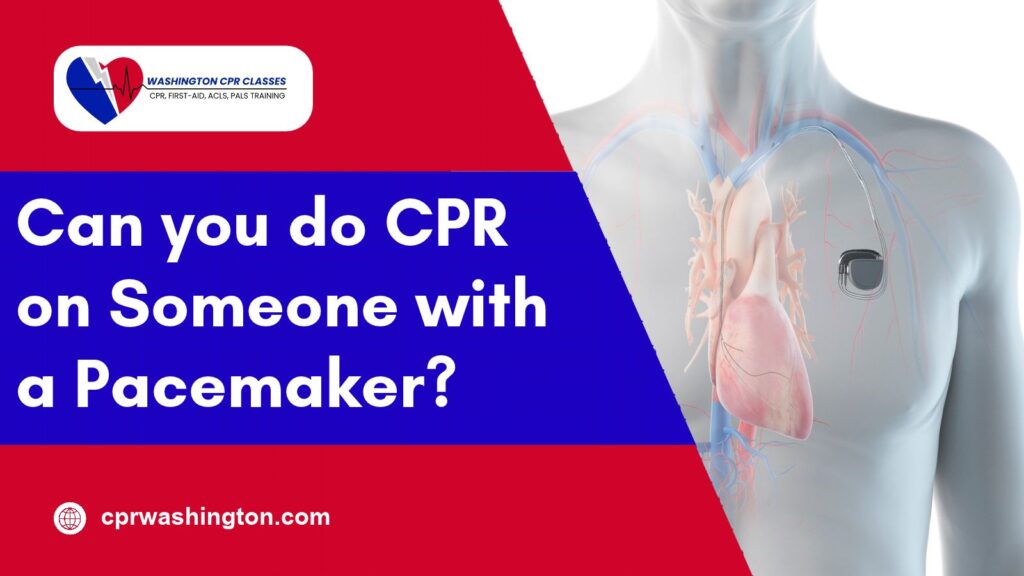
A pacemaker may sometimes be visible or easy to feel beneath the skin, particularly in the upper chest near the collarbone. If you notice a raised area that could be the pacemaker, do not press on it, move it, or try to remove it. More importantly, don’t delay CPR while trying to locate or identify the device. If the person is unresponsive and not breathing normally, start chest compressions in the center of the chest as you normally would.
If an AED is available, follow its instructions for placing the pads. Avoid placing an AED pad directly over a visible or palpable pacemaker; instead, position the pad so it is clear of the implanted device while maintaining appropriate pad placement. The presence of a pacemaker should never be a reason to withhold CPR or delay the use of an AED during a suspected cardiac arrest.
Does CPR Damage a Pacemaker?
CPR involves firm, repeated pressure on the chest, so it can potentially cause injuries, but concern about damaging a pacemaker should never be a reason to delay or avoid CPR. A pacemaker is designed to be implanted beneath the skin, typically in the upper chest, while standard adult CPR compressions are performed in the center of the chest. If a person is unresponsive and not breathing normally, maintaining blood flow to the brain and other vital organs is the immediate priority.
You should not try to move, protect, or remove the pacemaker before starting chest compressions. Perform CPR using the standard technique and use an AED when available, following its instructions. After the emergency, medical professionals can examine the person and check the pacemaker for any damage or malfunction. In a suspected cardiac arrest, delaying lifesaving CPR because of the implanted device can be far more dangerous than the possibility of device damage.
What If the Person Has an ICD Instead of a Pacemaker?
An implantable cardioverter-defibrillator (ICD) is different from a pacemaker, although some ICDs can also provide pacing. An ICD is designed to detect certain dangerous heart rhythms and can deliver electrical therapy, including a shock, when needed. If you aren’t sure whether the person has a pacemaker or an ICD, don’t delay CPR to find out. If they are unresponsive and not breathing normally, call emergency services and begin CPR immediately. You can perform CPR on someone with an ICD using the standard chest-compression technique.
Get Trained to Respond to Cardiac Emergencies
Knowing how to recognize cardiac arrest, perform high-quality CPR, and use an AED can help you respond quickly when someone with a pacemaker or ICD experiences a life-threatening emergency. An implanted cardiac device should not prevent you from starting CPR or using an AED when indicated. Hands-on CPR and AED training gives you practical experience with chest compressions, emergency response, and AED use so you can act promptly when every second matters.
To build these lifesaving skills, CPR Washington provides American Heart Association (AHA) authorized courses designed for different training needs. Join a BLS certification course, designed for both healthcare providers and non-healthcare providers, to learn CPR, AED use, and other essential emergency response techniques. You can also enroll in ACLS and PALS certification classes based on your training needs. Complete the online portion at your own pace, attend a short, hands-on skills session, and get certified the same day after completing the required training.