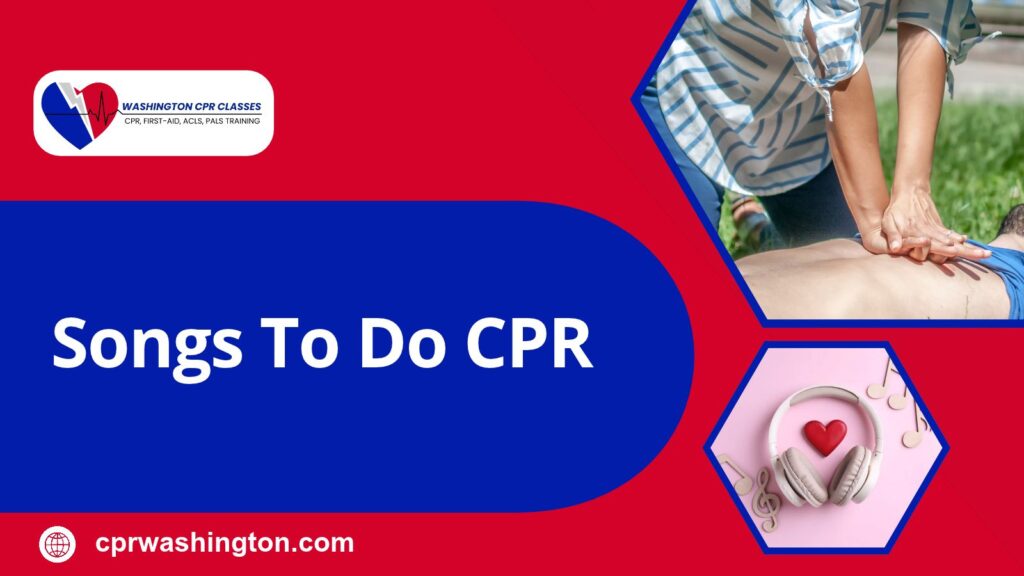
CPR songs are popular songs with a steady beat that helps people practice the recommended chest compression rhythm during cardiopulmonary resuscitation (CPR). Songs such as “Stayin’ Alive” by the Bee Gees are widely associated with CPR because their tempo is close to the recommended rate of 100 to 120 chest compressions per minute for adults.
Other popular songs, including “Dancing Queen” by ABBA and “Eye of the Tiger” by Survivor, are also used as rhythm references during CPR training. Choosing a song with an appropriate tempo helps learners practice a consistent pace, but effective CPR also requires the correct compression depth, full chest recoil, and minimal interruptions. Whether you are learning CPR for the first time or refreshing your lifesaving skills, understanding how CPR songs work helps you use music appropriately during practice and recognize when emergency action takes priority.
In this blog, you’ll learn what CPR songs are, the correct chest compression rate, the best songs for CPR with their approximate BPM, and how to use music to maintain a consistent rhythm during practice and real emergencies.
What Is a CPR Song?
A CPR song is a familiar song with a beat that helps rescuers maintain a consistent chest compression rate during CPR practice. The beat is measured in beats per minute (BPM), which indicates how many beats occur in one minute. For example, a song with a tempo of 110 BPM provides approximately 110 beats per minute, making it suitable for practicing the recommended adult chest compression rhythm.
CPR songs are commonly used in CPR classes, first aid training, and individual practice sessions. They give learners an easy-to-remember rhythm without requiring them to count every compression independently. However, the song’s tempo is only a guide. Following a beat does not automatically ensure correct hand placement, compression depth, chest recoil, or overall CPR quality.
What Is the Correct CPR Compression Rate?
The recommended chest compression rate for adult CPR is 100–120 compressions per minute. A song within this tempo range can help you remember the pace, but you must also maintain the correct compression depth and allow the chest to recoil fully between compressions.
Here is how beats per minute relate to CPR:
| Tempo | What it means for CPR |
| 100 BPM | Lower end of the recommended rate |
| 110 BPM | Near the middle of the recommended range |
| 120 BPM | Upper end of the recommended rate |
| Below 100 BPM | Too slow to match the recommended rate |
| Above 120 BPM | Too fast to match the recommended rate |
For an average adult, compress the chest at least 2 inches (5 cm) deep while avoiding depths greater than 2.4 inches (6 cm). Allow full chest recoil after every compression and minimize interruptions.
Remember that the correct CPR rhythm is only one component of high-quality CPR. A song can help you maintain speed, but it cannot tell you whether you are compressing deeply enough or allowing complete recoil.
What Is the Best Song for CPR?
“Stayin’ Alive” by the Bee Gees is one of the best-known songs for CPR because its tempo is approximately 103 beats per minute (BPM), which falls within the recommended adult chest compression rate of 100 to 120 compressions per minute.
The song’s steady rhythm makes it easier to remember the appropriate compression pace during CPR training and practice. Its title also reinforces the purpose of cardiopulmonary resuscitation: helping maintain blood circulation when someone experiences cardiac arrest.
Other songs, such as “Eye of the Tiger” by Survivor and “Just Dance” by Lady Gaga, also have tempos within the recommended range and may be suitable for CPR practice, depending on the recording. However, matching a song’s beat does not guarantee effective CPR. You must also maintain the correct compression depth, allow full chest recoil, and minimize interruptions. During a real emergency, never delay CPR to find or play a song.
Other Popular CPR Songs and Their BPM
Many popular songs have a steady rhythm that helps people practice chest compressions at the recommended rate of 100 to 120 compressions per minute for adults. These CPR songs range from classic rock and disco to modern pop, making it easier to find a familiar beat for CPR training.
The following table lists popular songs, their artists, and approximate beats per minute (BPM).
| Song | Artist | Approximate BPM |
| “Dynamite” | BTS | 114 |
| “Uptown Funk” | Mark Ronson ft. Bruno Mars | 115 |
| “Can’t Stop the Feeling!” | Justin Timberlake | 113 |
| “Dance the Night” | Dua Lipa | 110 |
| “Levitating” | Dua Lipa | 103 |
| “Havana” | Camila Cabello | 105 |
| “Flowers” | Miley Cyrus | 118 |
| “Thriller” | Michael Jackson | 118 |
| “Eye of the Tiger” | Survivor | 109 |
| “Rolling in the Deep” | Adele | 105 |
| “Call Me Maybe” | Carly Rae Jepsen | 120 |
| “The Middle” | Zedd, Maren Morris, and Grey | 107 |
| “Adventure of a Lifetime” | Coldplay | 112 |
| “Crazy in Love” | Beyoncé ft. Jay-Z | 99–100 |
| “Just Dance” | Lady Gaga | 119 |
| “Poker Face” | Lady Gaga | 119 |
| “Bad Romance” | Lady Gaga | 119 |
| “Hips Don’t Lie” | Shakira ft. Wyclef Jean | 100 |
| “I Will Survive” | Gloria Gaynor | 117 |
| “Girls Just Want to Have Fun” | Cyndi Lauper | 120 |
| “Man in the Mirror” | Michael Jackson | 100 |
| “Another One Bites the Dust” | Queen | 110 |
| “Walk Like an Egyptian” | The Bangles | 103 |
| “You’re the One That I Want” | John Travolta and Olivia Newton-John | 107 |
| “Sugar” | Maroon 5 | 120 |
| “Tik Tok” | Kesha | 120 |
| “All Star” | Smash Mouth | 104 |
| “The Final Countdown” | Europe | 118 |
| “Wannabe” | Spice Girls | 110 |
| “Billie Jean” | Michael Jackson | 117 |
| “Just a Girl” | No Doubt | 107 |
| “Bye Bye Bye” | *NSYNC | 118 |
| “More Than a Feeling” | Boston | 109 |
| “Grenade” | Bruno Mars | 110 |
| “Ring of Fire” | Johnny Cash | 105 |
| “Ice Ice Baby” | Vanilla Ice | 116 |
| “Work It” | Missy Elliott | 102 |
| “Suddenly I See” | KT Tunstall | 100 |
| “Crazy” | Gnarls Barkley | 112 |
| “Respect” | Aretha Franklin | 120 |
| “MMMBop” | Hanson | 104 |
| “Something Just Like This” | The Chainsmokers & Coldplay | 103 |
| “Wrecking Ball” | Miley Cyrus | 120 |
| “Hollaback Girl” | Gwen Stefani | 110 |
| “Love Story” | Taylor Swift | 117 |
| “Yellow Submarine” | The Beatles | 110 |
| “Dancing Queen” | ABBA | 100 |
| “I Will Survive” | Gloria Gaynor | 117 |
How Do CPR Songs Help You Maintain Chest Compression Rhythm?
CPR songs help you maintain chest compression rhythm by providing a familiar beat that matches the recommended adult CPR compression rate of 100–120 compressions per minute. Instead of estimating the speed or counting every compression, you can use the song’s rhythm as a mental guide to keep compressions consistent during practice.
Music can also make CPR training easier by helping learners associate a familiar melody with the correct compression pace. Songs such as Stayin’ Alive by the Bee Gees, with its approximate tempo of 103 beats per minute (BPM), are popular because their beats fall within the recommended range.
CPR songs can support learning in several ways:
- Maintain a consistent pace: A steady beat helps prevent compressions from becoming too slow or too fast.
- Improve rhythm recall: Familiar music can make the target compression rate easier to remember.
- Support CPR practice: Instructors can use songs during manikin practice to help learners develop a steady rhythm.
- Build confidence: Practicing with a familiar beat can help new learners become more comfortable maintaining the recommended pace.
How to Use a CPR Song During CPR
You can use a CPR song as a rhythm guide to help maintain the recommended adult chest compression rate of 100–120 compressions per minute. Songs such as Stayin’ Alive by the Bee Gees can help you remember the correct pace during CPR training. However, proper hand placement, compression depth, full chest recoil, and minimal interruptions remain essential for high-quality CPR.
Follow these steps to use a CPR song during practice:
1. Choose a song with the correct tempo. Select a familiar song with a steady beat between 100 and 120 BPM, such as Stayin’ Alive.
2. Position your hands correctly. For adult CPR, place the heel of one hand in the center of the chest, on the lower half of the breastbone. Place your other hand on top and interlock your fingers.
3. Match your compressions to the beat. Push down with each beat to maintain a consistent rhythm of 100–120 compressions per minute.
4. Maintain the correct compression depth. Compress an average adult’s chest at least 2 inches (5 cm) while avoiding depths greater than 2.4 inches (6 cm).
5. Allow complete chest recoil. Let the chest return to its normal position after each compression. Avoid leaning on the chest between compressions.
6. Minimize interruptions. Continue compressions while following your CPR training and emergency dispatcher instructions. If an AED is available, turn it on and follow its prompts.
Can You Use Any Song for CPR?
No, not every song is suitable for CPR. The best CPR songs have a steady tempo of 100–120 beats per minute (BPM), matching the recommended chest compression rate for adults. Songs that are too slow or too fast can make it harder to maintain the correct compression pace.
When choosing a song for CPR practice, consider these three factors:
- Correct tempo: Choose a song with a beat between 100 and 120 BPM.
- Familiarity: Select a song you know well so you can recall its rhythm without searching for it.
- Steady beat: Choose music with a consistent rhythm that is easy to follow.
You do not have to use an official CPR song. Any familiar song with a suitable tempo can help you practice maintaining the correct rhythm. However, matching the beat alone does not guarantee high-quality CPR. You must also maintain proper compression depth, allow complete chest recoil, and minimize interruptions.
Important: Use CPR songs as a learning aid, not as a requirement during an emergency. Never delay CPR to find music. Call emergency services, begin CPR when indicated, and use an automated external defibrillator (AED) as soon as one is available.
Should You Play CPR Songs During a Real Emergency?
No, you do not need to play CPR songs during a real emergency. Although songs such as Stayin’ Alive can help you remember the recommended adult chest compression rate of 100–120 compressions per minute, your priority is to begin CPR promptly, contact emergency services, and use an automated external defibrillator (AED) as soon as one is available.
If you witness someone collapse and the person is unresponsive and not breathing normally or is only gasping, follow these steps:
- Check scene safety: Make sure the area is safe before approaching.
- Call emergency services: Call your local emergency number or ask someone nearby to call and bring an AED.
- Begin CPR: Start chest compressions promptly. For an adult, push hard and fast in the center of the chest at 100–120 compressions per minute.
- Maintain compression quality: Compress at least 2 inches (5 cm) deep while avoiding depths greater than 2.4 inches (6 cm), allow complete chest recoil, and minimize interruptions.
- Use an AED: Turn it on as soon as it arrives and follow its voice prompts.
If you remember a CPR song, you can use its beat mentally to help maintain the correct rhythm. However, do not waste time searching for a song, opening a music app, or setting up a speaker. Follow emergency dispatcher instructions and the AED’s prompts.
The bottom line: CPR songs are useful for training and rhythm recall, but they are not necessary during an emergency. Prompt CPR, effective chest compressions, and early AED use are far more important than playing music.
Are CPR Songs Suitable for Children and Infants?
Yes, CPR songs can help rescuers maintain a steady compression rhythm when performing CPR on children and infants. The recommended chest compression rate is generally 100–120 compressions per minute for adults, children, and infants. However, the compression depth, hand placement, and resuscitation technique differ according to the person’s age and size.
Here is how CPR technique differs by age group:
- Adults: Compress the chest at least 2 inches (5 cm) deep while avoiding depths greater than 2.4 inches (6 cm). Use two hands on the lower half of the breastbone.
- Children: Compress approximately one-third of the chest’s front-to-back depth, about 2 inches (5 cm) for most children. Use one or two hands depending on the child’s size.
- Infants: Compress approximately one-third of the chest’s front-to-back depth, about 1.5 inches (4 cm). Use the appropriate infant compression technique based on current CPR guidance and the number of rescuers.
Although the rhythm can be similar, children and infants often require rescue breaths as part of CPR, particularly when cardiac arrest results from a breathing-related emergency. Parents, caregivers, childcare professionals, and others responsible for children should learn age-specific CPR techniques rather than relying on songs alone.
Remember: A CPR song can help you maintain the correct compression pace, but it cannot replace pediatric CPR training. In an emergency, call your local emergency number, follow the dispatcher’s instructions, and begin appropriate CPR without delaying to find a song.
Learn CPR With Hands-On Practice
CPR songs such as “Stayin’ Alive” by the Bee Gees can help you remember the recommended adult chest compression rate of 100–120 compressions per minute, making them useful for CPR practice and training. However, maintaining the correct rhythm is only one part of high-quality CPR; proper compression depth, full chest recoil, and minimal interruptions are equally important. Whether you are a beginner, caregiver, or healthcare professional, understanding CPR techniques can help you respond more confidently during a cardiac emergency.
Improve Your CPR Skills With Hands-On Training. Enroll in a CPR or Basic Life Support (BLS) course with us to practice chest compressions, rescue breathing, and AED use under expert guidance. At CPR Washington, our hands-on training helps you develop the practical skills needed to perform high-quality CPR and respond effectively when every second counts. Choose a course that fits your needs and gain the confidence to act when someone experiences cardiac arrest.