The Chain of Survival is a series of time-sensitive actions that improve the chances of survival for a person experiencing sudden cardiac arrest. It includes recognizing cardiac arrest, activating emergency medical services, performing high-quality cardiopulmonary resuscitation (CPR), using an automated external defibrillator (AED), providing advanced life support, and delivering post-cardiac arrest care. Each link represents an essential part of the emergency response, and delays in any step can reduce the chances of survival and recovery.
The Chain of Survival emphasizes the importance of early intervention, effective teamwork, and coordinated emergency care. Bystanders, trained CPR providers, emergency medical dispatchers, paramedics, and hospital teams all play important roles in helping a cardiac arrest victim survive. Starting CPR immediately and using an AED as soon as possible can help maintain blood flow and restore a normal heart rhythm when a shockable rhythm is present.
This guide explains the Chain of Survival, its links, why each step matters, and how CPR and AED training prepare people to respond to cardiac emergencies.
What Is the History of the Chain of Survival?
The Chain of Survival was introduced by the American Heart Association (AHA) in 1991 as a framework for improving survival after sudden cardiac arrest. The original model emphasized early access to emergency medical services, early CPR, early defibrillation, and advanced cardiac life support. It highlighted the importance of connecting time-sensitive interventions rather than treating each action as an isolated procedure.
Over time, the Chain of Survival evolved to reflect advances in resuscitation science and the importance of care after the heart resumes beating. In 2010, the AHA guidelines emphasized early recognition and activation of the emergency response system, high-quality CPR, rapid defibrillation, advanced life support, and post-cardiac arrest care. In 2020, recovery was added as another link, and separate chains were presented for adult and pediatric cardiac arrest occurring inside and outside hospitals. In 2025, the AHA consolidated these approaches into a single six-link Chain of Survival for adult and pediatric cardiac arrest, both in-hospital and out-of-hospital. The current framework includes recognition and emergency activation, high-quality CPR, defibrillation, advanced resuscitation, post-cardiac arrest care, and recovery.
What Are the Six Steps of the Chain of Survival?
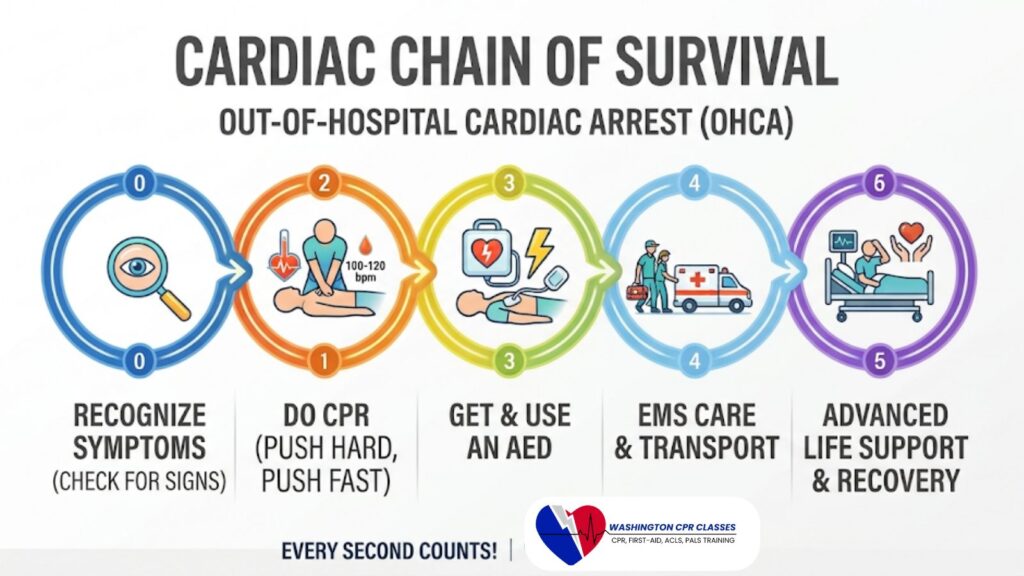
The Chain of Survival consists of six connected steps that improve the chances of survival after cardiac arrest. Each step focuses on a critical stage of emergency care, from recognizing cardiac arrest and starting CPR to providing advanced medical treatment and supporting long-term recovery.
Below are the six steps of the Cardiac Chain of Survival:
1. Recognize Cardiac Arrest and Activate Emergency Services
The first step is to recognize a possible cardiac arrest and activate the emergency response system. A person experiencing cardiac arrest is typically unresponsive and is not breathing normally. Occasional gasping, also called agonal breathing, is not normal breathing and should not delay CPR.
Check whether the person responds, assess breathing briefly, and ask someone to call the local emergency number and bring an AED. If you are alone and have a mobile phone, use speakerphone when possible so you can follow the dispatcher’s instructions while starting care.
Why it matters: Early recognition reduces delays in CPR, AED use, and professional medical assistance.
2. Perform High-Quality CPR
High-quality CPR helps circulate oxygenated blood to the brain and heart when the heart is no longer pumping effectively. Begin chest compressions promptly if the person is unresponsive and not breathing normally.
For an adult, perform chest compressions at a rate of 100–120 compressions per minute and a depth of approximately 2 inches (5 cm), while avoiding excessive depth. Allow the chest to recoil completely after each compression and minimize interruptions. Trained rescuers should provide rescue breaths according to their CPR training; hands-only CPR is an option for bystanders who are not trained or are unwilling to provide breaths.
Why it matters: CPR maintains partial circulation and can help preserve vital organ function until defibrillation or advanced care is available.
3. Use an AED for Early Defibrillation
An automated external defibrillator analyzes the heart’s rhythm and determines whether a shock is advised. Defibrillation can terminate certain dangerous rhythms, particularly ventricular fibrillation and pulseless ventricular tachycardia, allowing the heart an opportunity to resume an effective rhythm.
Turn on the AED, expose and prepare the chest, attach the pads according to the diagrams, and follow the device’s voice prompts. Ensure nobody touches the person during rhythm analysis and shock delivery. Resume CPR immediately after the shock or when the AED advises that no shock is needed.
Why it matters: Early defibrillation can be lifesaving when cardiac arrest is caused by a shockable rhythm. CPR should continue while the AED is being obtained and prepared.
4. Provide Advanced Life Support
Advanced life support (ALS) is provided by appropriately trained emergency medical professionals. Depending on the patient’s condition and local protocols, treatment includes rhythm assessment, advanced airway management, ventilation, medications, and identification of potentially reversible causes of cardiac arrest.
Emergency teams coordinate these interventions while continuing CPR and defibrillation when indicated. They also assess whether the patient has regained spontaneous circulation and determine the next stage of care.
Why it matters: Advanced life support builds on early CPR and defibrillation by addressing persistent cardiac arrest and treatable underlying causes.
5. Deliver Post-Cardiac Arrest Care
If a patient regains spontaneous circulation, immediate care continues. The medical team works to stabilize breathing and circulation, manage blood pressure and oxygenation, evaluate the cause of the arrest, and identify complications. Hospital treatment can include cardiac investigations, coronary intervention when indicated, temperature control and fever prevention, and neurological monitoring.
Regaining a pulse does not mean the emergency is over. The brain and other organs can remain vulnerable after cardiac arrest, making coordinated hospital care essential.
Why it matters: Post-cardiac arrest care helps prevent further injury, treats the underlying condition, and improves the opportunity for meaningful recovery.
6. Support Recovery and Rehabilitation
Recovery is the final link in the Chain of Survival. Survivors can experience physical weakness, memory or concentration difficulties, emotional distress, and other complications after cardiac arrest. Recovery needs differ from person to person.
Follow-up care can include cardiac rehabilitation, neurological assessment, physical and occupational therapy, psychological support, medication management, and guidance for returning to daily activities. Family members and caregivers can also need education and emotional support.
Why it matters: Survival is not the only goal. Recovery and rehabilitation help survivors regain function, manage long-term effects, and improve quality of life.
What Does Research Reveal About Survival at Each Link in the Chain of Survival?
Research shows that early intervention is associated with better outcomes after cardiac arrest. According to the American Heart Association’s 2025 statistics, based on 2024 U.S. data, 10.5% of adults treated by emergency medical services for out-of-hospital cardiac arrest survived to hospital discharge, while 8.2% survived with favorable neurological outcomes. These findings highlight the importance of early recognition, high-quality CPR, rapid defibrillation, advanced life support, and post-cardiac arrest care.
A 2024 study of 198,869 witnessed out-of-hospital cardiac arrests found that people who received bystander CPR within two minutes had an 81% higher likelihood of surviving to hospital discharge than those who received no bystander CPR. This observational finding reinforces the importance of starting CPR immediately and connecting each link of the Chain of Survival without unnecessary delays.
How Does Time to CPR and Defibrillation Affect Cardiac Arrest Survival?
Early CPR helps maintain blood flow to the brain and heart until further treatment becomes available, while rapid defibrillation can restore an effective rhythm in patients experiencing shockable cardiac arrest. Delays reduce the opportunity for successful resuscitation, making immediate CPR and prompt AED use essential.
Research cited in the American Heart Association’s adult Basic Life Support guidelines found that, among patients with witnessed out-of-hospital cardiac arrest caused by ventricular fibrillation, first-shock success was 93% when defibrillation occurred within six minutes, compared with 75% when the first shock was delayed beyond 16 minutes. These findings demonstrate the importance of rapid defibrillation, alongside high-quality CPR.
Why Is the Chain of Survival Important?
The Chain of Survival is important because sudden cardiac arrest can stop effective blood circulation within seconds. Without immediate intervention, the brain and other vital organs are deprived of oxygen, increasing the risk of permanent injury and death.
Each link addresses a different stage of the emergency. Recognizing cardiac arrest and calling for help starts the response, CPR maintains some blood flow, and defibrillation can restore an effective rhythm in suitable cases. Advanced life support and post-cardiac arrest care then address ongoing medical needs.
A weak or delayed link can compromise the entire response. For example, delaying CPR while waiting for an AED allows blood circulation to remain inadequate. Starting CPR immediately and using an AED as soon as it arrives gives the person the best opportunity for survival.
What Is the Difference Between the Adult and Pediatric Chain of Survival?
The Chain of Survival follows the same broad principle for adults and children: recognize the emergency, provide immediate resuscitation, and connect the patient with advanced medical care. However, the emphasis differs according to the most common causes of cardiac arrest and the patient’s age.
In adults, sudden cardiac arrest is often associated with a cardiac cause, including dangerous heart rhythms. Rapid recognition, high-quality CPR, and early defibrillation are especially important.
In infants and children, cardiac arrest more often follows respiratory failure or shock. Effective CPR that includes rescue breaths is therefore particularly important. Pediatric resuscitation also requires age-appropriate techniques, equipment, and protocols.
Always follow the appropriate adult or pediatric CPR guidelines and the instructions provided by emergency dispatchers.
What Is the Difference Between the Chain of Survival for Out-of-Hospital and In-Hospital Cardiac Arrest?
The Chain of Survival applies to cardiac arrest both outside and inside a hospital, but the response system differs according to the setting.
Out-of-Hospital Cardiac Arrest
Out-of-hospital cardiac arrest occurs in places such as homes, workplaces, public spaces, or community facilities. Bystanders often provide the first response by recognizing the emergency, calling emergency services, starting CPR, and locating an AED. Emergency medical services then provide advanced treatment and transport the patient for hospital care.
In-Hospital Cardiac Arrest
In-hospital cardiac arrest occurs in a healthcare facility. Staff may have access to continuous patient monitoring, trained resuscitation teams, defibrillators, and advanced airway equipment. Early recognition, rapid activation of the hospital response team, high-quality CPR, and prompt defibrillation when indicated remain essential.
In both settings, survival depends on coordinated action and minimizing delays between recognition, resuscitation, and definitive care.
How Does CPR Training Help Strengthen the Chain of Survival?
CPR training prepares people to recognize cardiac arrest and perform the actions that support the early links in the Chain of Survival. Training helps learners practice checking responsiveness and breathing, activating emergency services, delivering effective chest compressions, and using an AED safely.
BLS (Basic Life Support) courses are particularly relevant for healthcare professionals and other people who need structured training in CPR, AED use, and team-based resuscitation. CPR and AED courses also help workplace responders, caregivers, and members of the public develop practical emergency response skills.
Regular practice and refresher training help maintain technique and confidence. In an actual emergency, trained responders should act promptly, follow emergency dispatcher instructions, and continue CPR until the person shows signs of life, professional rescuers take over, the scene becomes unsafe, or they are physically unable to continue.
Are the Stroke Chain of Survival and Cardiac Arrest Chain of Survival the Same?
No, the Stroke Chain of Survival and the Cardiac Arrest Chain of Survival are not the same. Both emphasize early recognition, rapid emergency response, timely treatment, and recovery, but they address different medical emergencies. The Cardiac Arrest Chain of Survival focuses on restoring circulation through high-quality CPR, early defibrillation when indicated, advanced life support, and post-cardiac arrest care. The Stroke Chain of Survival focuses on recognizing stroke symptoms, activating emergency medical services, rapid hospital assessment, brain imaging, and appropriate stroke treatment.
The main difference is the initial treatment approach. Cardiac arrest requires immediate CPR and prompt AED use when available, while suspected stroke requires rapid emergency assessment to determine whether a blood vessel is blocked or bleeding is occurring in the brain. Treatments for ischemic and hemorrhagic stroke differ, so brain imaging is essential before selecting appropriate treatment. Although the two chains have different interventions, both rely on quick action and coordinated care to improve survival and health outcomes.
What Common Mistakes Can Weaken the Chain of Survival?
Several avoidable mistakes can delay lifesaving treatment or reduce CPR effectiveness:
- Failing to recognize abnormal breathing: Gasping is not normal breathing and should not delay CPR.
- Waiting too long to call emergency services: Activate the emergency response system as soon as cardiac arrest is suspected.
- Delaying chest compressions: Start CPR promptly rather than waiting for professional rescuers or an AED.
- Performing shallow or excessively fast compressions: Follow recommended adult compression depth and rate.
- Not allowing complete chest recoil: Let the chest return to its normal position after each compression.
- Interrupting compressions unnecessarily: Keep pauses as short as possible, including during AED use.
- Delaying AED application: Use an AED as soon as it is available and follow its prompts.
- Failing to resume CPR after AED analysis or a shock: Restart compressions immediately when directed.
- Neglecting post-cardiac arrest care: Successful resuscitation must be followed by appropriate medical evaluation and treatment.
Avoiding these mistakes helps connect each link and supports a faster, more coordinated response.
Get AHA CPR Certification and Learn Life-Saving Skills
The Chain of Survival is a coordinated sequence of lifesaving actions that improves the chances of surviving cardiac arrest. Recognizing the emergency, activating emergency services, performing high-quality CPR, delivering early defibrillation, providing advanced life support, and continuing with post-cardiac arrest care and rehabilitation are all essential parts of the process. Prompt action and effective coordination help reduce delays and support better outcomes.
If you want to respond confidently during a cardiac arrest emergency, consider enrolling in our AHA BLS, PALS, or ACLS certification classes. You will learn essential skills for recognizing cardiac arrest, performing high-quality CPR, using an AED, and supporting survival through timely emergency care. Complete your training on your schedule and receive your American Heart Association (AHA) certification eCard the same day you complete the required training and skills assessment. Build the knowledge and practical skills needed to make a difference when every second matters.