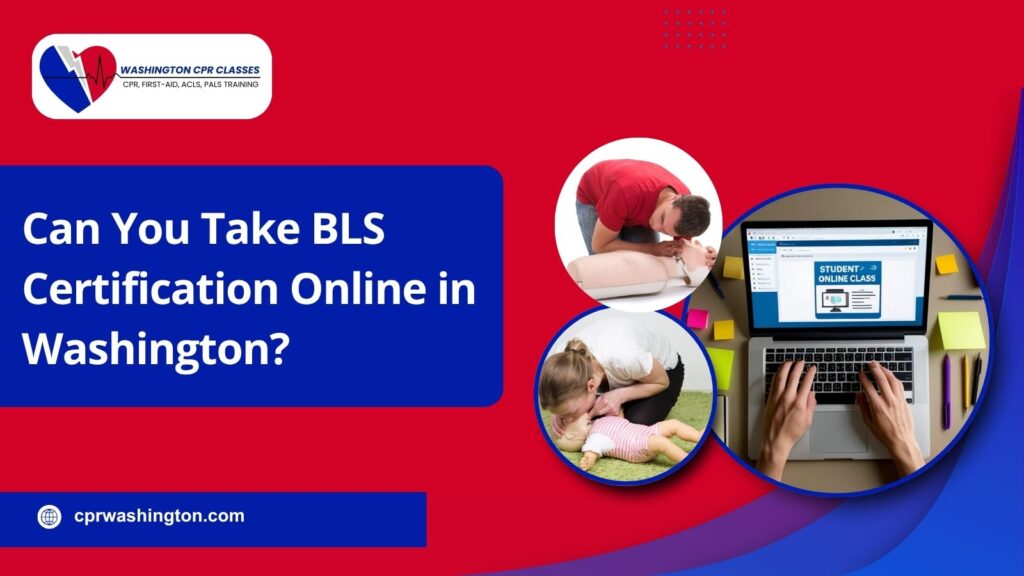
If you are a healthcare professional in Washington with a busy schedule, you may wonder whether you can take BLS certification online instead of attending a traditional classroom course. Online BLS training can make the learning process more convenient, but it is important to understand the difference between completing an online BLS course and receiving a legitimate BLS certification.
BLS certification requires both knowledge and practical skills. While the educational portion can be completed online through a blended or self-guided format, a hands-on skills session is required to demonstrate essential techniques such as CPR, AED use, rescue breathing, and other basic life support procedures. A completely online course that does not include a skills assessment may not meet your employer’s or school’s BLS requirements.
In this guide, you will learn whether you can get BLS certified completely online in Washington, how online and in-person BLS training work together, who needs BLS certification, how long the process takes, and how to choose a legitimate BLS course.
What Is BLS?
Basic Life Support (BLS) is emergency medical training that teaches healthcare professionals how to recognize and respond to life-threatening emergencies, particularly cardiac arrest and respiratory emergencies. BLS focuses on high-quality cardiopulmonary resuscitation (CPR), automated external defibrillator (AED) use, rescue breathing, and other essential lifesaving techniques.
BLS training typically covers adult, child, and infant CPR, AED use, choking relief, rescue breathing, and team-based resuscitation. Unlike general CPR courses, BLS is primarily designed for healthcare providers and other professionals who may be responsible for responding to medical emergencies as part of their work. Depending on the course format, BLS training may be completed through traditional classroom instruction or a blended format that combines online learning with an in-person skills assessment.
Can You Get BLS Certified Completely Online in Washington?
No, you cannot obtain a legitimate BLS certification completely online in Washington. However, you can get certified through a blended course that combines online training with an in-person, hands-on skills session. Be cautious of courses advertising “100% online BLS certification,” as legitimate BLS certification requires you to demonstrate essential lifesaving skills in person. The online portion covers the necessary knowledge and procedures, but it does not replace the required practical skills assessment.
With a legitimate blended BLS course, you complete the learning portion online and then attend an in-person skills session. During this session, you demonstrate skills such as adult, child, and infant CPR, AED use, rescue breathing, and other BLS techniques. If you need BLS certification for a healthcare job, nursing program, clinical requirement, or other professional purpose in Washington, make sure the course includes the required hands-on component.
Why Is an In-Person Skills Assessment Required Along with the Online Portion?
An in-person skills assessment is required because the online portion teaches you how to recognize cardiac arrest, perform CPR, use an AED, and respond to other emergencies, but simply understanding these procedures does not demonstrate that you can perform them correctly. The skills session allows you to practice and demonstrate the techniques under the observation of a qualified instructor or evaluator.
During the in-person skills assessment, you may be required to demonstrate:
- High-quality CPR: Performing chest compressions with proper technique and following the recommended compression rate and depth.
- AED use: Demonstrating how to safely operate an automated external defibrillator during cardiac arrest.
- Adult, child, and infant CPR: Adjusting CPR techniques appropriately for different age groups.
- Rescue breathing: Demonstrating appropriate ventilation techniques when required.
- Team-based resuscitation: Communicating and coordinating effectively with other rescuers during an emergency.
The hands-on assessment confirms that you can apply your BLS knowledge in a practical situation, not simply answer questions about it. This is why legitimate BLS certification combines the convenience of online learning with a required skills session when the certification program calls for hands-on verification.
How Does Legitimate BLS Certification Work in Washington?
Legitimate BLS certification in Washington typically involves more than completing an online exam. The exact process depends on the certification provider and the requirements of your employer, school, or profession. For healthcare-provider BLS, a common option is blended learning, which combines online coursework with a hands-on skills session.
A typical BLS certification process includes the following steps:
1. Choose an Appropriate BLS Course
Start by confirming which certification your employer, healthcare facility, school, or professional organization accepts. This is especially important if you need BLS for employment or clinical training.
2. Complete the Online BLS Training
The online portion covers the knowledge needed to respond to life-threatening emergencies. Depending on the course, topics may include CPR, AED use, rescue breathing, choking response, and recognition of cardiac arrest.
For example, the American Heart Association’s HeartCode BLS is designed as the online portion of its blended BLS course.
3. Complete the Hands-On Skills Session
For BLS courses that include psychomotor skills, completing the online portion alone is not enough to receive the course completion card. The learner must complete the required hands-on skills training and testing. The AHA states that its blended BLS format combines online learning with an in-person skills session with an instructor or, where available, a compatible manikin.
4. Demonstrate BLS Competency
During the practical portion, you may need to demonstrate skills such as high-quality CPR, AED use, ventilation techniques, and other BLS procedures. This allows the training provider to verify that you can apply the techniques you learned rather than simply recall information from an online test.
5. Receive Your BLS Certification
After successfully completing all required components, you receive the applicable BLS course completion credential. For example, the AHA states that its BLS Provider Course completion card is valid for two years.
Who Can Take a BLS Course in Washington?
A BLS course in Washington is primarily designed for healthcare professionals, students, and other individuals whose jobs require them to respond to cardiac or respiratory emergencies. However, you generally do not have to be a licensed healthcare professional simply to enroll in a BLS course. The specific certification you need depends on your employer, school, facility, or professional requirements.
Common BLS learners include:
- Registered nurses (RNs) and licensed practical nurses (LPNs)
- Nursing assistants
- Physicians and medical students
- EMTs and paramedics
- Dental professionals
- Medical assistants
- Respiratory therapists
- Healthcare and nursing students
- Other healthcare workers who may respond to emergencies
BLS can be appropriate for both in-hospital and out-of-hospital healthcare personnel, depending on their role and workplace. The right course ultimately depends on what your employer, school, clinical program, or licensing organization requires.
Is BLS the Same as CPR Certification?
No. BLS and CPR certification are related, but they are not exactly the same. Both teach lifesaving techniques, but they are designed for different audiences and may have different training requirements.
CPR certification generally focuses on cardiopulmonary resuscitation and is often designed for the general public, workplace employees, teachers, parents, caregivers, and others who may need to respond to an emergency.
BLS certification, or Basic Life Support certification, is more comprehensive and is primarily designed for healthcare professionals, trained first responders, and healthcare students. BLS training typically covers high-quality CPR, AED use, rescue breathing, recognition of cardiac arrest, choking response, and team-based resuscitation.
How Long Does Online BLS Certification Take?
The time required to complete online BLS certification in Washington depends on the course provider, training format, and whether a hands-on skills assessment is required. In many cases, the online portion can be completed in a few hours, while a blended BLS course requires additional time for the practical skills session.
For example, the American Heart Association states that its HeartCode BLS online portion takes approximately 1 to 2 hours, while the hands-on skills session typically takes about 60 minutes to 2 hours, depending on the learner’s experience.
How Long Does Each Part Take?
A typical blended BLS course may involve:
- Online coursework: Approximately 1–2 hours
- Online knowledge assessment: Included as part of the online course
- Hands-on skills session: Approximately 1–2 hours
- Certification: Issued after successfully completing the required course components
The actual time can vary. Someone familiar with CPR techniques may complete the training more quickly, while a first-time learner may need additional time to review the material and practice the skills.
How to Choose an Online BLS Course in Washington
Choosing an online BLS course in Washington requires more than looking for the cheapest or fastest option. Start by checking whether the course provides the type of BLS certification your employer, school, or clinical program requires. The American Heart Association recommends checking with your employer to make sure you select the correct course.
Before enrolling, consider these factors:
- Verify the certification provider: Make sure the course is provided by a recognized training organization and results in the credential you need.
- Check for a hands-on skills session: For BLS courses that require practical skills, the online portion should be followed by a hands-on skills assessment. AHA’s BLS blended-learning format combines online learning with a hands-on skills session.
- Confirm employer acceptance: If you need BLS for a healthcare job, nursing program, clinical placement, or another professional requirement, confirm that your employer or school accepts the specific course before paying.
- Understand the course format: Make sure you know whether you are purchasing a complete certification course or only the online learning portion. Completing an online portion alone may not result in the final BLS course completion card.
- Check the skills-session location: If an in-person session is required, choose a provider with a convenient Washington location and available appointment times.
- Review certification validity: Check how long the resulting BLS certification remains valid and understand the renewal requirements. For example, the AHA BLS Provider Course completion card is valid for two years.
The best online BLS course is therefore not simply the one that promises “100% online certification.” Instead, look for a legitimate course that provides the appropriate BLS credential, includes the required practical skills component, and meets your employer’s or school’s requirements
Get BLS Certified Online in Washington
You cannot obtain a legitimate BLS certification through a completely online course alone. However, you can get BLS certified by combining the online portion with an in-person BLS skills session. If you have a busy schedule and need to get certified quickly, a self-guided or blended BLS course in Washington can provide greater flexibility. In many cases, you may be able to complete the required training and skills assessment and get certified the same day. Before enrolling, verify the legitimacy and recognition of the training provider, confirm that the course meets your employer’s requirements, and choose the format that best fits your schedule.
If you’re looking for legitimate BLS certification in Washington, CPR Washington, powered by CPR VAM, offers training backed by more than 20 years of experience and thousands of healthcare professionals and members of the general public trained. Our AHA HeartCode BLS online portion, combined with an in-person skills session, is available in blended and self-guided formats to provide flexibility while helping you build practical skills for real-life emergencies. Get trained through a recognized program and earn an AHA BLS certification accepted nationwide, subject to your employer or organization’s specific requirements.