

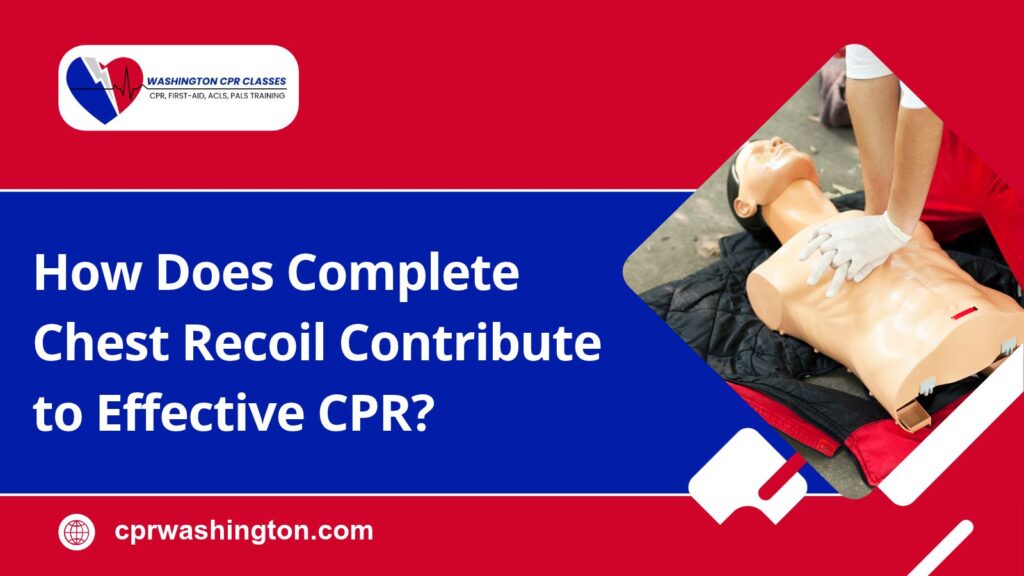
Complete chest recoil contributes to effective cardiopulmonary resuscitation (CPR) by allowing the chest to return to its normal position after every compression. This expansion lowers pressure inside the chest cavity, promotes venous return to the heart, and allows the heart chambers to refill with blood before the next compression. Without complete chest recoil, blood flow to vital organs, including the brain and heart, can decrease.
During CPR, rescuers must release all downward pressure between compressions without lifting their hands completely off the patient’s chest. Complete chest recoil works alongside proper compression depth and rate to maintain blood circulation during cardiac arrest.
This guide explains the importance of complete chest recoil, its effects on blood circulation, and how to maintain proper chest expansion while performing high-quality CPR.
What Is Complete Chest Recoil in CPR?
Complete chest recoil in CPR refers to allowing the chest wall to return to its normal, uncompressed position after each chest compression. When a rescuer releases downward pressure, the chest naturally expands, creating a pressure difference inside the thoracic cavity that helps draw blood back into the heart.
During adult CPR, rescuers should compress the chest at a rate of 100 to 120 compressions per minute and a depth of at least 2 inches (5 cm), while avoiding excessive depth greater than 2.4 inches (6 cm). Between compressions, they must allow the chest to expand fully before applying the next compression.
Complete chest recoil does not require rescuers to lift their hands entirely off the chest. Instead, they should maintain proper hand contact while removing all downward pressure. This prevents interruptions in compression rhythm and allows natural chest expansion.
Why Is Complete Chest Recoil Important During CPR?
Complete chest recoil is important because it supports blood return to the heart and helps maintain the circulation generated by chest compressions. When the chest expands after each compression, pressure inside the chest decreases, allowing blood to flow back into the heart and refill its chambers.
The following are four important ways complete chest recoil contributes to effective CPR:
1. Promotes Venous Return to the Heart
Venous return refers to the movement of blood through the veins back to the heart. During CPR, complete chest recoil allows the chest cavity to expand, lowering intrathoracic pressure and helping draw blood into the right side of the heart.
This process replenishes the blood available for circulation during the next compression. When rescuers lean on the chest between compressions, the pressure inside the chest remains elevated, restricting venous return and reducing the amount of blood returning to the heart.
2. Allows the Heart to Refill Between Compressions
During cardiac arrest, the heart cannot pump blood effectively on its own. Chest compressions temporarily generate the circulation needed to deliver oxygenated blood to vital organs.
Complete chest recoil provides a relaxation phase that allows blood to return to the heart and refill its chambers. This prepares the heart for the next compression and supports the amount of blood circulated during CPR.
Without adequate recoil, the heart has less opportunity to refill between compressions, which can reduce the effectiveness of subsequent compressions.
3. Supports Coronary Perfusion Pressure
Coronary perfusion pressure is the pressure gradient that drives blood through the coronary arteries to supply the heart muscle.
During CPR, adequate coronary perfusion is essential because the heart needs oxygenated blood to support its electrical and mechanical recovery. Complete chest recoil lowers intrathoracic pressure during the relaxation phase, helping maintain the pressure gradient required for coronary blood flow.
In contrast, leaning on the chest between compressions can increase intrathoracic pressure and reduce coronary perfusion pressure, making resuscitation less effective.
4. Helps Maintain Blood Flow to the Brain and Other Vital Organs
The brain and heart require a continuous supply of oxygenated blood to function. During cardiac arrest, chest compressions help maintain circulation when the heart cannot pump effectively.
Complete chest recoil supports venous return and cardiac filling, helping maintain the forward blood flow generated by compressions. This contributes to cerebral and coronary perfusion, which are essential goals of high-quality CPR.
What Happens if You Do Not Allow Complete Chest Recoil During CPR?
Failing to allow complete chest recoil reduces the effectiveness of chest compressions by preventing the chest from returning to its normal position. When a rescuer leans on the chest between compressions, residual pressure increases intrathoracic pressure and interferes with blood returning to the heart.
The main consequences of incomplete chest recoil include:
- Reduced venous return: Increased pressure inside the chest restricts blood flow back to the heart.
- Poor cardiac filling: The heart receives less blood between compressions, reducing the amount available for circulation during subsequent compressions.
- Decreased coronary perfusion pressure: Incomplete recoil can reduce the pressure gradient needed to deliver blood to the heart muscle.
- Reduced cerebral perfusion: Poor circulation can limit the blood supply reaching the brain.
- Lower CPR effectiveness: Restricted blood return and inadequate chest expansion compromise an important component of high-quality CPR.
The American Heart Association (AHA) identifies complete chest recoil as an important element of high-quality CPR. Its 2025 Adult Basic Life Support Guidelines recommend allowing complete chest wall recoil, such as by avoiding leaning on the chest between compressions.
How Can You Ensure Complete Chest Recoil During CPR?
Rescuers can ensure complete chest recoil by releasing downward pressure after every compression while maintaining proper hand contact with the patient’s chest. Correct body positioning, hand placement, and compression technique help prevent leaning and support consistent chest expansion.
Follow these six techniques to maintain complete chest recoil:
- Maintain proper hand placement: Place the heel of one hand on the center of the chest, over the lower half of the sternum. Place your other hand on top and interlock your fingers.
- Position your body correctly: Keep your shoulders directly above your hands and your arms straight to deliver consistent compressions.
- Release downward pressure: After each compression, remove pressure completely so the chest can return to its normal position.
- Avoid leaning on the chest: Do not rest your body weight on the patient’s chest between compressions. Maintain hand contact without applying downward force.
- Maintain the correct compression rhythm: For adults, deliver 100 to 120 compressions per minute while allowing complete recoil after each compression.
- Use CPR feedback devices: When available, audiovisual feedback devices can help identify incomplete chest recoil and guide rescuers in correcting their compression technique.
Important: Complete chest recoil does not mean lifting your hands entirely off the chest. It means removing all downward pressure while maintaining hand contact so the chest can expand naturally before the next compression.
Is Complete Chest Recoil as Important as Compression Depth and Rate?
Yes. Complete chest recoil is just as important as proper compression depth and rate because all three contribute to effective chest compressions during CPR. Adequate depth generates blood flow, the correct rate maintains consistent compressions, and complete recoil allows blood to return to the heart between compressions.
The 2025 AHA Adult Basic Life Support Guidelines identify adequate compression depth, an appropriate compression rate, and complete chest recoil as key components of high-quality CPR.
The recommended adult chest compression targets are:
| CPR component | Recommended target |
| Compression rate | 100–120 compressions per minute |
| Compression depth | At least 2 inches (5 cm), avoiding depths greater than 2.4 inches (6 cm) |
| Chest recoil | Allow complete chest expansion after every compression |
| Compression interruptions | Keep interruptions as short and infrequent as possible |
These components work together rather than independently. For example, compressing at the correct rate and depth does not guarantee high-quality CPR if the rescuer continuously leans on the chest. Similarly, allowing complete recoil cannot compensate for compressions that are too shallow or too slow.
Therefore, rescuers should maintain the correct compression rate and depth while allowing full chest expansion between every compression.
What Is the Difference Between Complete and Incomplete Chest Recoil?
The main difference between complete and incomplete chest recoil is whether the chest returns to its normal position after each compression. Complete recoil allows natural chest expansion, while incomplete recoil occurs when the rescuer maintains downward pressure between compressions.
The following table highlights the differences:
| Feature | Complete chest recoil | Incomplete chest recoil |
| Chest position | Returns to normal position | Remains partially compressed |
| Downward pressure | Fully released | Residual pressure remains |
| Venous return | Supports blood returning to the heart | Restricts blood return |
| Cardiac filling | Allows the heart to refill | Can reduce heart filling |
| Intrathoracic pressure | Decreases during recoil | Remains relatively elevated |
| CPR effectiveness | Supports effective circulation | Compromises CPR quality |
Complete chest recoil is achieved by releasing all downward pressure without removing the hands from the patient’s chest. Incomplete recoil occurs when rescuers lean on the chest, often because of fatigue, poor positioning, or an attempt to maintain a fast compression rhythm.
Does Complete Chest Recoil Apply to Adults, Children, and Infants?
Yes. Complete chest recoil is essential during CPR for adults, children, and infants. Rescuers should allow the chest to return fully to its normal position after every compression, regardless of the patient’s age.
However, compression depth and hand placement vary according to the patient’s age and size. The 2025 AHA guidelines emphasize complete chest recoil as a component of high-quality CPR for both adult and pediatric patients.
The recommended compression techniques and depths include:
- Adults: Compress the chest at least 2 inches (5 cm), while avoiding excessive depth greater than 2.4 inches (6 cm). Use two hands on the lower half of the sternum.
- Children: Compress approximately one-third of the chest’s anterior-posterior diameter, about 2 inches (5 cm). Use one or two hands depending on the child’s size.
- Infants: Compress approximately one-third of the chest’s anterior-posterior diameter, about 1.5 inches (4 cm). Use the heel of one hand or the two-thumb encircling-hands technique.
For all three age groups, rescuers should release downward pressure completely between compressions while maintaining proper hand contact.
The important point is that complete chest recoil is not limited to adult CPR. It is a fundamental part of effective chest compressions for patients of all ages.
Improve Your CPR Skills With Professional CPR Certification Training
Understanding chest recoil, compression depth, and compression rate is essential for delivering high-quality CPR during cardiac emergencies. Proper CPR training helps healthcare professionals and other rescuers develop the practical skills needed to perform effective chest compressions, use an automated external defibrillator (AED), and respond confidently when someone experiences cardiac arrest.
Enroll in professional CPR certification training with CPR Washington to strengthen your life-saving skills. Whether you need Basic Life Support (BLS), Advanced Cardiovascular Life Support (ACLS), or Pediatric Advanced Life Support (PALS), professional training provides the knowledge and hands-on practice needed to respond effectively. Choose a convenient training option that combines online learning with an in-person skills session to build confidence without disrupting your busy schedule.